
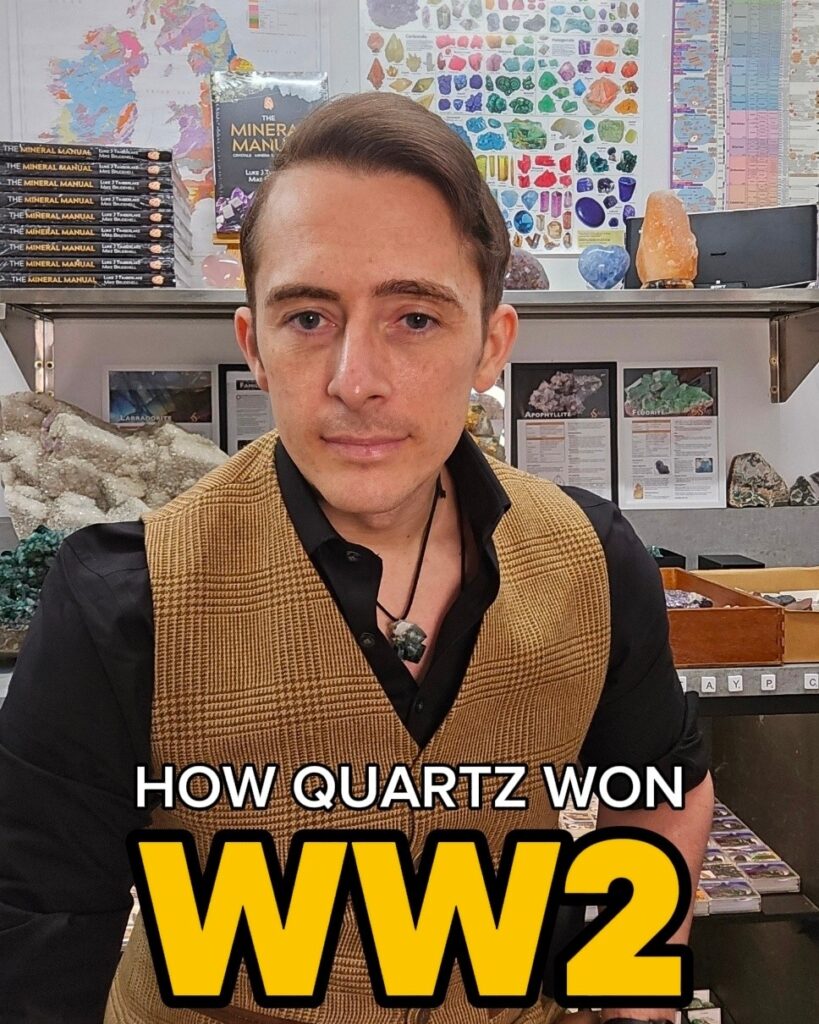
Did Quartz Help Win World War Two?
Quartz Crystals, Radio Communication & Piezoelectricity
A Blog by Luke J Timberlake
I don’t want this to sound crazily dramatic, because quartz didn’t “win” World War Two, but it played a role profoundly more significant than people like to imagine. It’s one of those things that tends to get either wildly overstated or completely ignored depending on who’s talking about it.
Quartz didn’t “win a war”. Certainly not in any mystical or poetic sense. It didn’t channel any bloody energy, shift timelines, or do anything remotely resembling the sort of nonsense people like to attach to it today… but it did play an important role.
One that shouldn’t be set aside merely because it’s tricky to make a film out of it. Although honestly, I doubt it’s undoable.
Quartz Crystals & Wartime Communication
In truth, quartz simply made communication… well… communicable.
And given war hadn’t moved too far away from communicating with flags and trumpets, it’s hard to explain how significant this actually was. Especially when you’re dealing with large groups of people trying not to accidentally kill one another.
Or at the very least… shoot in the right direction.
I’m going to try and break this down without the broad tendency to overcomplicate the subject.
Importantly, quartz is piezoelectric.
Which is more or less a needlessly intimidating way of saying this:
- apply pressure and it produces an electrical charge
- apply electricity and it vibrates
That’s it.
Something I really want to ram home because the piezoelectric effect is seemingly jet fuel for every mischaracterisation surrounding quartz in New Age literature.
Mechanical stress. Electrical charge. That’s it.
Physics.
The Piezoelectric Effect & Quartz Frequency Stability
The useful part is that those measurable vibrations happen at an extremely consistent frequency when the quartz crystal is cut properly. And that consistency is where everything starts to become genuinely useful.
Because before this, radio systems were… not great.
In fact, they were dreadful.
Meaning people would often have to pivot back to:
- runners
- Morse code
- carrier pigeons
The issue was frequency drift.
You’d set a frequency and then:
- temperature changes
- power fluctuations
- environmental conditions
…would quietly nudge it off course.
Not by much, but enough to create real problems.
Stations would overlap. Signals would interfere. Clarity would drop.
Which is acceptable if you’re half-listening to music.
Less fine if you’re trying to coordinate something that depends entirely on timing… like a war.
Understand that it was quartz that fixed this.
Once a quartz crystal was cut to a specific frequency, it stayed there.
Stable. Predictable.
Radios could transmit and receive on precise frequencies without wandering off course.
Clearer signals meant:
- less interference
- better coordination
- more reliable communication
And during wartime, that mattered enormously.
Why Quartz Became So Important
Initially, quartz crystal systems weren’t widely adopted.
They were:
- expensive
- awkward
- time consuming
And, in hindsight, dismissing them was a fairly poor decision.
Because once it became obvious that crystal-controlled radio systems were significantly more reliable, the shift wasn’t gradual.
It was immediate.
And somewhat pivotal.
Which created a slightly awkward problem because there wasn’t an existing industry prepared to supply what had suddenly become essential.
Meaning one had to be built.
Quickly.
What followed was less a neat pre-planned industrial rollout and more outright improvisation. Machinery was adapted, manufacturing processes were invented on the fly, and people worked to tolerances so fine they were measuring fractions of a millimetre most of us wouldn’t even consciously register.
All while not fully understanding the underlying physics surrounding what they were doing.
Certainly not in the way we understand it now.
Despite this… production scaled rapidly.
Brazil, Quartz Mining & Supply Problems
There was, however, a serious issue with supply.
Quartz is extremely abundant, but high-quality quartz suitable for radio crystal oscillators is not.
Most of it had to be sourced from Brazil.
Even then, a significant portion of what arrived was completely unusable. Each quartz crystal had to be inspected for internal fractures and flaws, often by submerging it in oil simply to see what was happening inside the crystal structure.
Meaning only a fraction of the material was suitable.
Any seasoned mineral collector reading this will already understand how difficult it is to find quartz without imperfections.
Now imagine trying to do that on an industrial wartime scale.
That’s the nature of the problem they were dealing with.
Because quartz crystal material was so critical, shipments were treated with a seriousness usually reserved for things capable of exploding.
And demand certainly didn’t slow down.
If anything, it increased.
Because once you start relying on something that makes your communication systems actually function reliably, you don’t casually pivot back to the version that didn’t.
Quartz, Radar & Modern Technology
And it wasn’t just radios benefiting from quartz crystal oscillators.
The same principles fed directly into:
- radar
- sonar
- timing systems
- telecommunications
…all of which were absolutely vital during World War Two.
There’s also a slightly ironic component to this.
Older radio systems were easier to detect, meaning using them could effectively reveal your position to the enemy.
Crystal-controlled systems reduced that problem considerably.
So quartz didn’t just make communication clearer… it made communication less conspicuous.
Meaning it didn’t just make firing in the correct direction easier, it made the enemy firing accurately in yours… harder.
After the war, the infrastructure and scientific knowledge surrounding quartz technology didn’t disappear.
It carried over into civilian technology.
Quartz oscillators became standard in:
- clocks
- watches
- broadcasting
- computing
- telecommunications
- electronics
In fact, pick up a modern piece of technology and there’s a good chance it still relies on the exact same principle.
Even something as mundane as a disposable lighter uses it.
Quartz Crystals, “Energy” & Modern Misconceptions
So no, quartz didn’t single-handedly “win” anything.
But it absolutely helped underpin a massive shift in how reliably humans could communicate and measure time, which turns out to be significantly more important than most people give it credit for.
The slightly amusing part is where we’ve ended up.
You’ve got a mineral that played a very real and very practical role in the development of modern technology, and somehow the conversation surrounding quartz has drifted back into vague discussions about “energy”, vibrations, and personal transformation.
A conversation that, from observation, seems to stem largely from misunderstandings surrounding the piezoelectric effect:
- what it is
- why it happens
- what it’s actually for
In fact, I’d wager you’d struggle to find a single crystal healing book that doesn’t mischaracterise the piezoelectric effect to lay the groundwork for some intoxicating untruth.
Which is, if nothing else, an impressive example of just how far people can wander away from the point.
— Luke J Timberlake ✏️
I genuinely enjoyed this article. The explanation of how quartz stabilised radio frequencies during WWII was surprisingly fascinating, especially the connection between piezoelectricity and communication systems. It’s refreshing to see quartz discussed from a scientific and historical perspective instead of the usual myths surrounding it.
I genuinely enjoyed this article. The explanation of how quartz stabilised radio frequencies during WWII was surprisingly fascinating, especially the connection between piezoelectricity and communication systems. It’s refreshing to see quartz discussed from a scientific and historicall perspective instead of the usual myths surrounding it.