
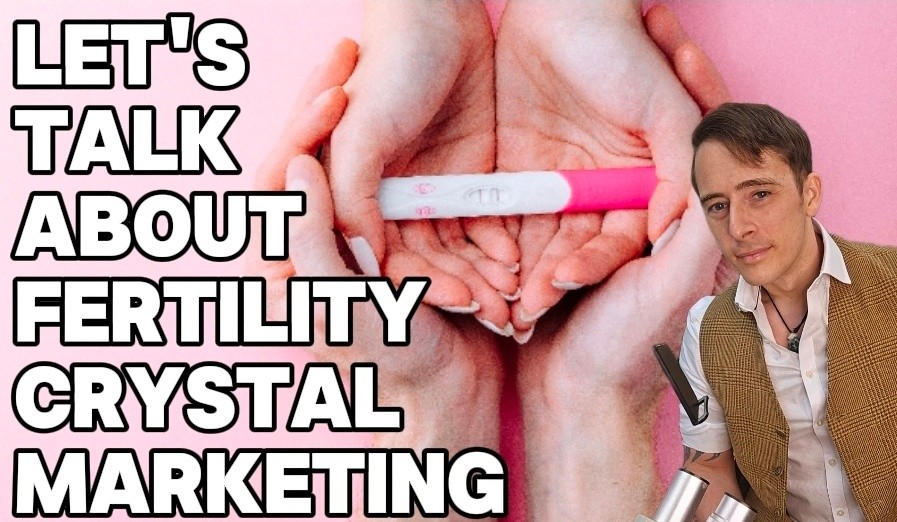
Fertility Crystals, False Hope & Predatory Marketing
A Blog by Luke J Timberlake ✏️
There are a whole bunch of predatory marketing techniques that punctuate this industry. Some are worse than others, and some are even worse than the one I’m discussing today. But just because something questionable exists on a spectrum doesn’t mean each area of that spectrum doesn’t deserve scrutiny.
The more you look at this very stylised form of crystal marketing, the more it starts to feel less like harmless nonsense and more like something deliberately engineered to sit directly on top of vulnerability. Not accidentally either. It’s bloody deliberate.
You’ll see it wrapped in soft, suggestive language like:
- “supporting fertility”
- “balancing reproductive energy”
- “encouraging feminine harmony”
…alongside neat little bundles of polished stones sold as though they’re somehow active participants in a biological process that, for most people, requires absolutely none of this.
And that’s the part that irritates me.
Because it relies on a quiet assumption that people won’t stop and interrogate what’s actually being implied.
Well… I am.
Fertility Is Not a Geological Process
Let’s not pretend reproduction is some obscure, inaccessible mechanism that only a select few people can navigate or understand. For the overwhelming majority of people, it is a straightforward biological function… preceded by an activity we are literally wired to enjoy.
Yes, orgasms are probably something we evolved to encourage reproduction.
Not optimise… not ritualise… not accessorise… enjoy.
This is not a system that evolved to require intervention from a polished mineral, and the moment you start framing it that way, the whole premise begins to look slightly absurd. Especially once profit becomes attached to it.
Because at that point, it stops being belief and starts becoming business.
Once you strip the language back, it becomes painfully obvious who this sort of marketing is actually aimed at… because it certainly isn’t aimed at people who conceive easily.
They don’t need help, meaning they don’t seek it.
Which means, by process of elimination, it’s aimed at people who struggle.
And struggle is the operative word here.
People who are already in a difficult emotional position… already questioning what’s wrong… already looking for anything that might give them an edge, or at the very least a sense of control over a situation that often feels painfully outside of it.
That’s where this stops being mildly irritating and starts becoming something far more deliberate.
Suggestion Without Accountability
If you are selling products into that emotional space without evidence, without mechanism, and without anything beyond suggestion, then you are not helping… you are capitalising.
That’s the word for it, and I think it’s important to be direct about it.
Crystal-based fertility claims simply do not stand up to scrutiny.
There is:
- no established physiological pathway
- no credible body of evidence
- no consistent measurable outcome
…just a loop of vague assertions about “energy” that conveniently cannot be tested, demonstrated, or meaningfully verified.
And that’s exactly why the language surrounding these products is always so careful.
You’ll almost never see someone outright say:
“This crystal will help you conceive.”
Because that would require accountability.
Instead, you get phrases like:
- “supports fertility”
- “encourages reproductive balance”
- “promotes feminine energy”
- “assists conception journeys”
All implication… no commitment.
Just enough suggestion to plant an idea, but never enough to be held responsible for it.
It gives sellers room to profit from false hope whilst insulating themselves behind ambiguity and carefully chosen wording.
The Business Behind the Belief
Honestly, I don’t think that carefulness is accidental… I think it’s structural.
Because if these claims were genuinely self-evident… if there was something observable, repeatable, undeniable behind them… they wouldn’t need to be marketed this aggressively in the first place.
They would sustain themselves naturally.
People recommend things that actually work directly, confidently, and without hesitation. Real solutions spread through word of mouth because people experience results and tell others about them.
It becomes advice, not inventory… something shared, not something packaged and sold.
But that isn’t what’s happening here.
Instead, the belief has to be:
- introduced
- framed
- softened
- romanticised
- aestheticised
- monetised
And the moment it requires monetisation to survive, you’ve already exposed the weakness in it.
Because now there’s a financial incentive attached to whether or not somebody accepts the claim… and that financial incentive doesn’t target people who are fine.
It targets people who are vulnerable.
That’s the bit I find difficult to ignore.
Why I Don’t Think This Is Harmless
It isn’t harmless to suggest that a piece of quartz or carnelian has some meaningful role to play in conception when someone is already struggling with the emotional reality that it isn’t happening.
It isn’t harmless to wrap that suggestion in language that sounds supportive while quietly extracting money from people who are, quite understandably, looking for anything that might help.
And it definitely isn’t harmless to hide behind the word “belief” when the entire thing is functioning as a business model.
Believe whatever you like… genuinely, that’s not the issue.
But the moment you attach a price tag to that belief, package it into a product, and aim it directly at people in emotionally difficult situations, it stops being belief and starts becoming commerce.
And if that commerce is built on claims that do not hold up to scrutiny, aimed at people who are least equipped emotionally to challenge them, then I don’t think it deserves to be defended as some harmless little corner of wellness culture.
Personally, I think it deserves to be called what it is.
Predatory.
Because people struggling with fertility deserve:
- support
- compassion
- medical guidance
- honesty
…not some parasite wedged in the middle trying to elicit profit from desperation.