
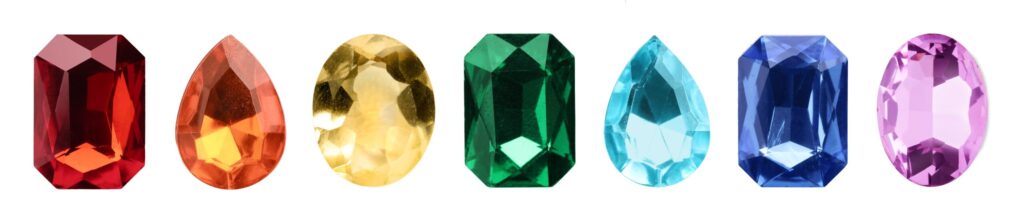
WHAT DOES A CARAT MEAN?
What Does Carat Mean? A Guide to Gemstone Weight
By Luke J. Timberlake
If you’ve ever browsed a jeweller’s window, watched someone propose with a diamond ring, or spent any time reading about gemstones, you’ve almost certainly come across the word carat.
It’s one of those terms everyone recognises, yet surprisingly few people know exactly what it means. Does it measure a gemstone’s size? Its quality? Its value?
Not quite.
Let’s clear up the confusion.
Understanding Gemstone Weight?
A carat (ct) is the standard unit used to measure the weight of gemstones—not their size.
One carat is equal to:
- 0.2 grams (200 milligrams)
- Five carats = 1 gram
- Six carats = 1.2 grams
Simple enough.
The confusion comes from the fact that larger gemstones usually weigh more, but weight and size are not the same thing.
Why Two One-Carat Gemstones Can Look Different
Not all gemstones have the same density.
A one-carat diamond and a one-carat piece of amber both weigh exactly the same, but because amber is much less dense, it will appear significantly larger.
Likewise, a dense gemstone such as sapphire or ruby may look smaller than a gemstone of the same weight made from a lighter material.
This is why jewellers always quote carat weight rather than physical dimensions when describing gemstones.
Why Equal Weights Can Look Different
To demonstrate this, imagine carving a perfect 1 cm³ cube from several different gemstones.
Although every cube is exactly the same size, they would all have different weights.
| Gemstone | Approximate Weight |
|---|---|
| Ruby | 20.10 ct |
| Sapphire | 19.90 ct |
| Diamond | 17.55 ct |
| Emerald | 16.60 ct |
| Pearl | 13.65 ct |
| Amethyst | 13.30 ct |
Same size.
Different weights.
That’s why carat measures mass, not physical dimensions.
Does a Higher Carat Mean a More Valuable Gem?
Not necessarily.
Carat weight is only one factor that determines value.
Professional gemmologists also consider:
- Colour
- Clarity
- Cut
- Transparency
- Rarity
- Origin
- Overall quality
For example, a flawless one-carat diamond can be worth considerably more than a heavily included three-carat diamond.
Likewise, a small Alexandrite or fine Cat’s Eye Chrysoberyl may command a far higher price than much larger gemstones.
Where Does the Word “Carat” Come From?
The word carat originates from the Greek word keration, meaning carob seed.
For centuries, merchants believed carob seeds were remarkably consistent in weight and used them as makeshift balances for weighing precious stones.
Modern research has shown that carob seeds actually vary considerably in weight, so they were never as reliable as people once believed. Nevertheless, the name survived long after the practice disappeared.
When Was the Modern Carat Introduced?
Before the twentieth century, different countries used slightly different definitions of a carat, making international gemstone trading rather confusing.
Everything changed in 1907, when the Fourth General Conference on Weights and Measures officially adopted the metric carat, defining it as exactly 200 milligrams (0.2 grams).
Today, this standard is used worldwide.
What Are Gemstone Points?
Because gemstones can be incredibly small, jewellers often use points instead of fractions of a carat.
- 1 carat = 100 points
- 50 points = 0.50 carats
- 25 points = 0.25 carats
- 10 points = 0.10 carats
This allows gemstones to be measured with remarkable precision.
Carat vs Karat
These two words are often confused, but they describe completely different things.
Carat (ct) measures the weight of gemstones.
Karat (K) measures the purity of gold.
For example:
- A 2-carat diamond weighs 0.4 grams.
- 18-karat gold contains 75% pure gold.
Different words.
Different measurements.
Final Thoughts
So now you know.
A carat measures weight—not size.
It’s one of the most important measurements used in gemmology, but it is only part of the story. A gemstone’s beauty, rarity, colour and clarity are often just as important as its weight.
The next time someone proudly tells you they’ve bought a “two-carat diamond”, you’ll know exactly what they’re talking about—and perhaps even surprise them by explaining why another two-carat gemstone might look completely different.
After all, learning about geology and gemstones is half the fun.