
SPOTTING FAKE MOLDAVITE
What Is Moldavite?
Moldavite is a natural tektite a form of silica rich glass created around 15 million years ago when a massive meteorite struck what is now southern Germany.
The impact generated unimaginable temperatures, melting rock before launching it high into the atmosphere. As the molten material cooled, it fell back to Earth across parts of Central Europe, where it solidified into the beautiful green glass we know today.
Almost all genuine Moldavite comes from the Czech Republic, with only tiny amounts found in neighbouring regions. Its extraordinary origin, striking appearance and increasing rarity have made it one of the world’s most sought-after collector’s minerals.
Why Is Fake Moldavite So Common?
Over the past few years, Moldavite has exploded in popularity.
Social media platforms, crystal communities and spiritual influencers have all contributed to an unprecedented surge in demand. At the same time, commercial extraction has slowed dramatically, with many traditional mining operations having closed or becoming increasingly restricted.
The result is simple economics.
Demand continues to rise while supply becomes ever more limited.
Whenever this happens, counterfeit products inevitably flood the market.
Today, much of the fake Moldavite sold online is nothing more than moulded or melted glass made to resemble genuine specimens. Some copies are crude, while others are remarkably convincing.
Fortunately, there are several reliable ways to spot the difference.
1. Don’t Be Fooled by Certificates of Authenticity
This is probably the biggest misconception surrounding Moldavite.
People often assume that a certificate guarantees authenticity. Unfortunately, there is no universally recognised authority issuing certificates for Moldavite.
Many certificates are designed on a home computer, printed by the seller and included simply because buyers expect them.
A certificate is only as trustworthy as the person issuing it.
Rather than relying on paperwork, focus on the quality of the specimen and the reputation of the supplier.
2. Genuine Moldavite Doesn’t Look Wet
One of the easiest visual clues is the surface appearance.
Fake Moldavite often has an oily, glossy or almost “wet” look. This happens because it’s usually manufactured from melted glass, which naturally develops a smooth, shiny finish.
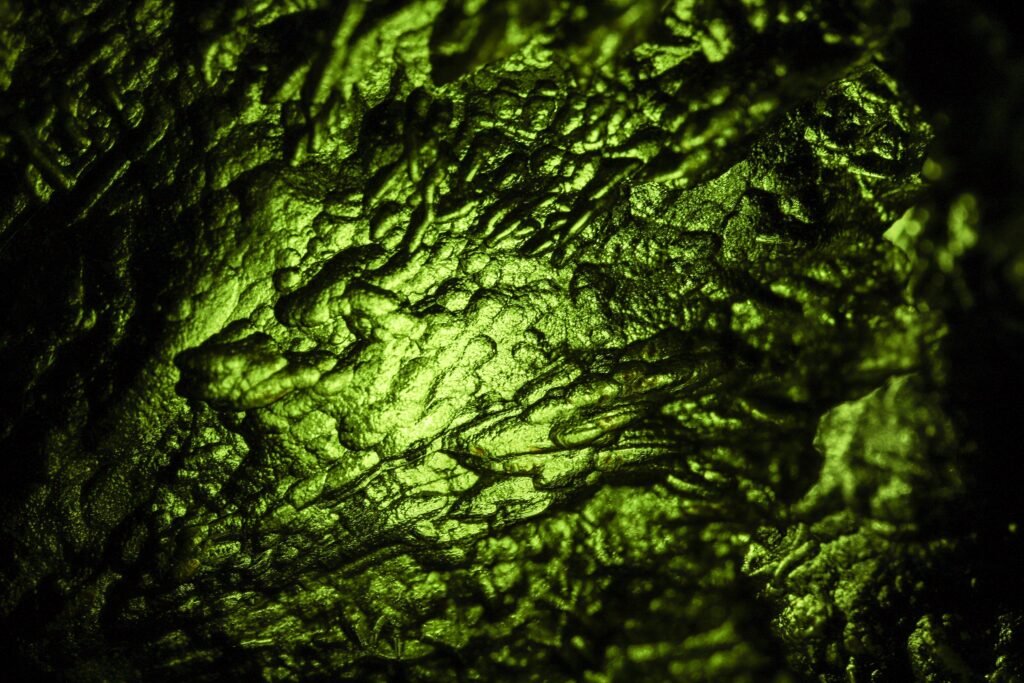
Authentic Moldavite has a much more natural texture. Although it can display a subtle lustre, it shouldn’t resemble polished bottle glass fresh from the dishwasher.
If it looks unusually glossy, treat it with caution.
3. Buy From Reputable Sellers
Choosing the right supplier is one of the most effective ways to avoid buying fake Moldavite.
This can feel difficult if you’re buying your first piece, but there are several things worth checking.
Read independent reviews.
Ask questions.
Find out exactly where the Moldavite originated.
A reputable dealer should be able to tell you where their specimens were sourced and answer questions confidently.
If a seller struggles to explain the origin of their stock or avoids answering straightforward questions, that’s usually a warning sign.
It’s also worth remembering that not everyone selling fake Moldavite knows it’s fake. Some have unknowingly bought counterfeit stock themselves.
4. Be Careful Where You Buy
Some online marketplaces are significantly riskier than others.
Websites such as eBay are flooded with imitation Moldavite, while certain overseas marketplaces have become well known for mass-producing fake specimens.
Etsy can be an excellent place to buy genuine crystals, but it requires careful research. There are many reputable sellers alongside many that simply aren’t.
Always judge the individual seller rather than the platform itself.
5. Look for Natural Gas Bubbles
One of the most reliable characteristics of genuine Moldavite is the presence of tiny natural gas bubbles trapped within the glass.
These formed during the violent cooling process after the meteor impact.
Depending on the specimen, they may be visible with the naked eye or easier to see under magnification.
Many fake specimens lack these natural inclusions altogether.
Of course, this is usually something you examine after purchase, so it’s better used to confirm authenticity than to decide whether to buy in the first place.
6. Consider the Size
Large pieces of genuine Moldavite are exceptionally rare.
Specimens weighing over 100 grams command extremely high prices because so few exist.
If someone offers you a huge piece for what appears to be a bargain, alarm bells should start ringing.
Likewise, don’t assume an expensive price automatically means it’s genuine. Some counterfeit sellers deliberately charge premium prices to create the illusion of authenticity.
Always assess the specimen itself, not just the price tag.
7. Check the Colour
Authentic Moldavite is usually found in shades of olive green, forest green or greenish-brown.
The colour should appear natural rather than vivid or artificial.
Bright red Moldavite simply doesn’t exist in nature.
Equally, specimens that appear jet black or unnaturally bright green should be treated with scepticism.
Under ultraviolet light, genuine Moldavite remains largely inert.
8. If It’s Too Cheap, There’s Usually a Reason
Moldavite has never been inexpensive.
As supplies continue to diminish and collector demand increases, prices have risen dramatically.
While it’s impossible to quote a fixed price because the market changes constantly, genuine Moldavite should never be considered a budget purchase.
If a deal appears unbelievably good, it almost certainly is.
Why Genuine Moldavite Is Becoming Harder to Find
One of the biggest reasons for the increase in counterfeit material is the simple fact that genuine Moldavite is becoming increasingly difficult to source.
Many traditional mining operations have ceased, while existing supplies are largely held by collectors and specialist dealers.
At the same time, worldwide demand continues to increase.
Whenever a product becomes scarce and valuable, counterfeit versions inevitably become more sophisticated.
That’s exactly what’s happening with Moldavite today.
Final Thoughts
Buying genuine Moldavite doesn’t have to be intimidating, but it does require a little knowledge.
Forget certificates of authenticity.
Instead, learn what genuine Moldavite looks like, ask questions, buy from reputable suppliers and be wary of deals that seem too good to be true.
If you’re ever unsure about a specimen, we’re always happy to offer advice. If necessary, we’ll even examine it under magnification and give you our honest opinion.
A little caution today could save you a costly mistake tomorrow.
Frequently Asked Questions
Does real Moldavite contain bubbles?
Yes. Genuine Moldavite typically contains tiny natural gas bubbles formed during its creation after a meteorite impact.
Can Moldavite be faked?
Absolutely. Most fake Moldavite is manufactured from moulded or melted glass designed to imitate the appearance of genuine specimens.
Does a certificate prove Moldavite is genuine?
No. Certificates are not regulated and should never be relied upon as proof of authenticity.
Where is genuine Moldavite found?
Almost all genuine Moldavite originates from the Czech Republic, with very small quantities found in neighbouring areas.
Watch Our Video Guide to Genuine Moldavite
If you’d like to see genuine Moldavite up close and learn more about identifying authentic specimens, be sure to watch our dedicated YouTube video.
We cover many of the points discussed in this guide, along with close-up footage of genuine Moldavite to help you recognise the characteristics of the real thing before you buy.
🎥 Watch here: https://www.youtube.com/watch?v=pIFf3aDBHUM
If you find the video helpful, don’t forget to like, subscribe, and leave us a comment. We regularly upload new videos covering crystals, minerals, fossil identification, buying guides and expert advice.
.