
TEKTITES
A Blog by Luke J. Timberlake
Humans have been fascinated by objects that fall from the sky for thousands of years. Meteorites and tektites provide a tangible connection to the violent events that have shaped both our planet and the wider Solar System.
In this guide, we’ll explore some of the best-known extraterrestrial materials found on Earth, including Moldavite, Tektites (Indochinites), Pallasite Meteorites and Libyan Desert Glass. Although each has a different origin, they all tell an incredible story of cosmic impacts and planetary history.
What Are Tektites?
Tektites are pieces of natural glass created when a large meteorite strikes the Earth’s surface. The tremendous heat and pressure generated during the impact melt silica-rich rocks, launching molten material high into the atmosphere. As this material cools, it solidifies into glass before falling back to Earth.
Unlike meteorites, tektites are formed from terrestrial material rather than the meteorite itself. Their composition and appearance vary depending on the location and geology of the impact site.
Moldavite
Moldavite is perhaps the world’s most famous tektite. This beautiful green natural glass formed around 15 million years ago when a large meteorite struck what is now southern Germany, creating the Ries impact crater.
The impact melted silica-rich rocks and blasted molten material hundreds of kilometres across Europe. As it cooled while travelling through the atmosphere, it formed the distinctive green glass known as moldavite.
Today, genuine moldavite is found almost exclusively in the Czech Republic, with smaller occurrences in neighbouring countries. Its rarity, striking colour and fascinating origin have made it one of the most sought-after specimens among mineral collectors.
Indochinite Tektites
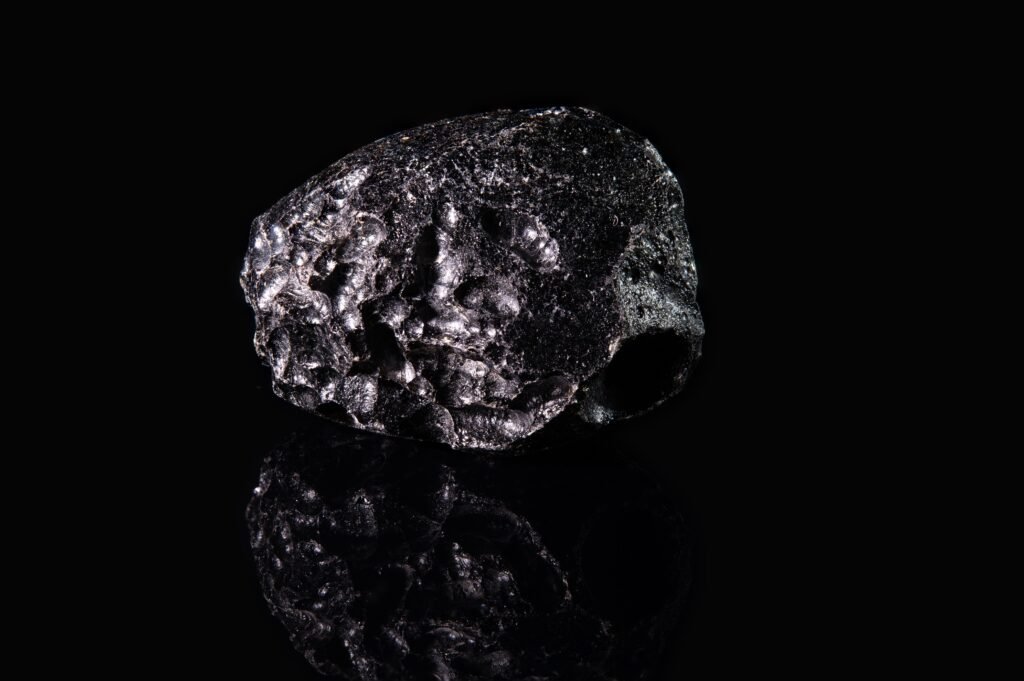
Often sold as Tibetan Tektites or simply black tektites, these specimens belong to the wider tektite family.
They formed following an enormous meteorite impact in Southeast Asia around 790,000 years ago. Scientists believe the impact scattered molten material across a vast area that includes modern-day Thailand, Vietnam, Laos, Cambodia and parts of China.
Although these tektites appear jet black, holding one against a bright light usually reveals a deep cola-brown colour.
Indochinites are much more common than moldavite, making them an affordable way to own a genuine piece of impact history.
Pallasite Meteorites
Unlike tektites, pallasites are true meteorites.
These extraordinary specimens consist of an iron-nickel metal framework containing transparent crystals of olivine, the gemstone variety of which is known as peridot.
Many scientists believe pallasites formed near the boundary between the metallic core and rocky mantle of an ancient asteroid or protoplanet that was later shattered during a colossal collision.
Because they originate beyond Earth, pallasites are among the few genuine extraterrestrial gemstones known to science. Their striking combination of polished metal and golden-green crystals makes them some of the most beautiful meteorites ever discovered.
Libyan Desert Glass
Libyan Desert Glass is another remarkable natural impact glass.
It occurs across the Great Sand Sea in the Western Desert of Egypt and eastern Libya, where bright yellow fragments lie scattered among the sand dunes.
Scientists believe the glass formed around 29 million years ago when an enormous meteorite impact—or possibly an atmospheric explosion—generated temperatures exceeding 1,600°C. These extreme conditions melted almost pure silica sand into the beautiful golden glass seen today.
Interest in Libyan Desert Glass stretches back more than 3,000 years. One of its most famous appearances is in the burial treasures of Tutankhamun, whose ceremonial breastplate features a carved scarab made from this remarkable material.
Meteorites vs Tektites
Although the two are often confused, meteorites and tektites are not the same thing.
- Meteorites are pieces of rock or metal that originated in space before surviving their journey through Earth’s atmosphere.
- Tektites are natural glass created from Earth’s own rocks after the heat of a meteorite impact melts and ejects them into the atmosphere.
Both provide valuable evidence of ancient impact events and help scientists understand the history of our Solar System.
Final Thoughts
Whether you’re fascinated by geology, astronomy or natural history, tektites and meteorites offer a unique connection to events that occurred millions—or even billions—of years ago. From the emerald-green beauty of moldavite to the spectacular crystal-filled structure of pallasite meteorites, these remarkable specimens remind us that Earth’s story has always been shaped by the wider universe.
Want to learn more? Follow Salt Shack on YouTube for educational videos covering minerals, crystals, meteorites and the fascinating geology of our planet.